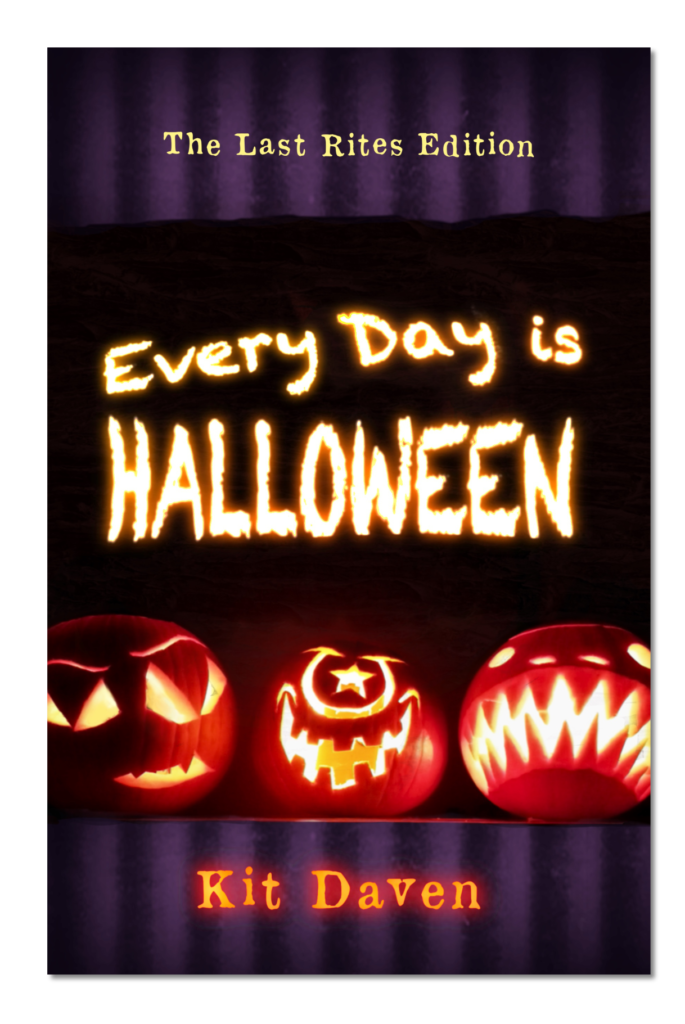
Every Day is Halloween
Enjoy this sample from the deliciously creepy, occasionally gruesome story…
Every Day is
Halloween
Written by Kit Daven
Copyright © 2024 by Kit Daven.
All rights reserved, including the right to reproduce, distribute, or transmit in any form or by any means.
May

Esther knelt before the front yard’s retaining wall, where she clipped six new tulip blooms before their tangerine blush drew unwanted attention to her home. She wasn’t the only one to worry about the flowers, though.
Her bestie, Rebecca, who lived a few houses down, had helped her parents dig up every rosebush on the property. In Rebecca’s words, “Frickin’ no way we’re chopping off every flower as soon as it blooms. My mom’ll be in tears all the time.”
Farther down, where Wolfe Street dead-ended at the edge of a shroud of trees, even Hope Cemetery looked dreary. The caretakers had removed flowers and wreaths from every grave site. It was safer that way. Less work.
Everyone on Wolfe Street had given up gardening. After the first week of spring, not a single place in Hopetown grew flowers.
For Esther, nurturing the tulips was worth the risk. This way she could enjoy—however briefly—a remnant of the world that existed before Halloween came to stay last year. She just had to dispose of the blooms quickly.
Each decapitated bloom fell, rolled briefly along the ground, remaining vibrant. It’s not right, Esther thought bravely. They ought to die in their own way, in their own time, like nature intended.
She scratched at the skull mask covering her face, felt the weight of the robe’s hood on her head, knowing she’d never express these thoughts to anyone. Not now; at least, not until Halloween ended.
Esther wished life didn’t have to be this way. She missed walking with Rebecca to school, joking and laughing and acting silly. Now, if they didn’t want to be bussed or driven to school, they had to walk in groups. They had to look over their shoulders, be mindful of every little thing they did or said or wore, especially when they walked past the cemetery.
Whenever they started down the dirt path at the end of the road, they rushed angst-filled through the Amber Woods to avoid encounters. Only when the path veered away from the cemetery’s iron fence and exited onto Hazel Street did they find relief. And they always had to be dressed in some kind of Halloween costume. That way, they wouldn’t get heckled or yelled at, pinched, punched . . . or worse.
This morning, before the decapitations, there was no sign of Ms. Avery puttering around in her front yard. No one wandered the streets—not even the Dead. Their absence provided Esther a rare opportunity to photograph the tulips with her emergency phone, which she kept hidden in a secret pocket in her black robe. After school, she’d share the image with her friends on her laptop—her preferred device for communication. Preserving the blossoms on their stalks this way wasn’t quite the same as enjoying them in real life, but it was close enough.
Barely enough.
Esther froze. Something stirred in the bush beside her neighbour’s garage. From beneath the branches, a skinny black cat named Mishu crawled stiffly out and limped toward her.
Mishu stopped at the retaining wall and leered at the stems still tipped with fat buds, ready to bloom in the next day or two.
Esther counted a dozen more blooms to behead. A dozen more rectangular holes to dig, each with its own pile of dirt; little graves, each big enough to hold one blossom.
Mishu wheezed a raspy growl of disgust.
A shiver betrayed Esther as she tried her best to ignore Mishu’s dissatisfaction.
I’m safe. The pumpkins on the stoop are holding it together. They haven’t rotted entirely. Yet.
To be certain, she glanced at them over her shoulder. Squirrels had gnawed at the eyes and mouths. Within the misshapen eyes, the sacred Om symbols carved on the inside remained whole, protecting the stoop and the door to the house.
Other wards marked the windows along the side of the house, and an altar in the back kept the patio door and yard safe. These markings kept the Dead from scratching at their house day and night or spying up close through their ground-floor windows.
Tomorrow morning, I won’t bother to photograph the tulips. I’ll get on with the beheadings. Maybe if I get up early enough, Mishu’ll be clawing at Ms. Avery’s door. Or maybe she’ll be wandering down to the other end of the street, past Rebecca’s place, past Devesh’s. I’ll spend more time with the tulips; I will.
But Mishu was here, now, staring at her.
On impulse, Esther clasped her mask’s plastic chin. She meant to push it upwards a bit on her sweaty face but stopped herself. The skull mask hid her well, except for her blue eyes, clear and bright—a dead giveaway that she was very much alive.
Mishu didn’t seem to notice.
Or maybe . . . Maybe you don’t care. As long as I look dead, that’s enough, right? Then Esther promised herself, One day, I’ll move my mask around, see if you’ll screech and call the others. Or maybe you’ll attack me?
Esther hiked the robe’s threadbare sleeves past her elbows so they wouldn’t snag on the retaining wall. Bones ran along the top and bottom of each arm—hand-painted lines along the black long-sleeved jersey she wore underneath. She noted how cracked and faded they looked.
Time to repaint those soon. Ooh, a craft day!
Esther endured the scrutiny of Mishu’s dark almond eyes as she gathered up the decapitated blossoms and laid them in their individual graves. One by one, she covered them with a pile of loose dirt, then gently patted the mounds flat.
Mishu purred with delight—a raspy, unearthly sound. “Saaay wooords.”
Esther’s breath hitched as her neck hairs prickled. Hearing Mishu speak unsettled her, triggering her instinct for self-protection. She tugged the sleeves of her black robe back down, feeling safer—albeit warmer—with an extra layer of fabric between them.
Weird! Why would she wanna give Last Rites to a flower? Esther wondered.
Culling the tulips, burying them: that was important. By squashing out life, Esther proved to Mishu they shared something in common—she wanted the same outcome, even if deep down she didn’t. Esther had figured this out last year, on the morning of the first day of The Rising. Memories of that fateful day replayed in her mind—a day made even stranger because it had been a very sunny Halloween . . .
“Esther! Get your butt down here! The skull donuts’ll be gone if we don’t get to the market five minutes ago.”
Recognizing the impatience in her mother’s tone, Esther flew down the stairs and pulled her favourite fall jacket from the closet. While slipping it on, her hand brushed against the edge of a photo frame on the wall next to the door: a picture of her and her mom from two summers ago, taken by her father when he was still around. She straightened it, then patted the front pocket of her jacket, felt the outline of her phone there.
I wanna kiss Carter. The thought popped out of nowhere as she tugged on a pair of red and white Vans and laced them up. Weird! I mean, there are cuter guys, right? And he’s so quiet all the time, which makes him, I dunno, mysterious? I wonder if he likes freckles. Can’t change those. But I can maybe dye my hair blue sometime. Anything other than boring brown. Maybe one day?
Esther followed her mother out onto the front stoop. Sucking in a breath of cold air, she shut the door and listened to the whir of the mechanism locking behind them.
At this end of the side yard, a pile of leaves beckoned to Esther. Soon, soon. After more leaves fall from the trees, I’ll rake you into an even bigger pile. More cushion for me when I jump into you.
Also impressive was the pumpkin she and her mom had carved together. “Hey, Dopey,” she whispered to it, but the pumpkin just sat on the stoop looking at nothing in particular with its perfectly slanted eyes, mouth wide in a toothy smile.
From the corner of Esther’s eye, she spotted a young boy. She was certain he lived on the street behind hers. Usually he looked dazed, with a goofy grin and the kind of cowlick that frustrated hairdressers. She tried to recall his name so she could say hi. Lou? Louis? Something like that, I think.
He ran between her yard and the neighbours’, eyes wide, lips grimacing, then disappeared behind a shed. Huh? Strange kid!
While Esther waited for her mother to climb down the steps toward the car, a vehicle peeled out of a driveway a few houses down, across from the cemetery, and flew down the street past their house.
“Mom?”
“Hm, I didn’t know there was a funeral today,” her mother said, staring past the retaining wall, down and across the street at the cemetery’s iron picket fence.
Usually, when a funeral was underway, people parked along Wolfe Street only when the front gate parking lot was full. Today the street was clear. “Aren’t any cars,” Esther said.
She waited for her mother to move down the steps, but she stood frozen. Finally, after a moment, Esther peered around her mother and gawped at the strange-looking people dressed in vintage clothes, dirty clothes. “What the—” her mother began then abandoned her words.
The people trailed out of the back gate of the cemetery and along the street, slow and plodding. Some of them shuffled along, clearly old and ailing. Others seemed younger, gliding along with more ease, more grace. Grief ringed their eyes.
“Maybe it’s a funeral march,” Esther suggested. Strange! There’s no music.
“I—” her mother began. Again, she didn’t finish her sentence.
“Must’ve been a big funeral…” Esther suggested until a man dressed in a black suit and a top hat turned to look back over his shoulder. Tiny beams of sunlight sliced through his body.
“Mom?” Esther tugged on the back of her mother’s jacket. Could be a trick of the light. Mom, would know.
The man turned a bit more to make way for a woman in a blue dress. No light shone through her. But the man with the top hat? Light still shone through him.
“Mom? Do you see that? Why can I see through that man?” Holy crap! I can see through one, two . . . a bunch of ‘em.
“Mom?”
Then a woman in a blue dress scratched her ear, and it fell off, tumbled down her back and onto the ground. Oh, fuuug!
“Mom!”
The procession shambled quietly toward Ms. Avery’s house across the street first, her property being beside the cemetery. Beneath a bay window, her English teacher squatted before her small garden, the hem of her smock dress hitched up onto her chubby thighs. Unaware of the procession, she yanked out weeds and tossed them over her shoulder.
The closer the cemetery people got to her, the more they fixated on her; the more they sneered. When the man in the top hat was within arm’s reach, Ms. Avery finally noticed them. She jumped up, yelped, and ran up the porch steps back into her house like she was a young girl again.
Esther’s mother gasped. “Ba-ack in the house.”
Across the street, the people in the procession turned to stare at her. They’d heard her. Somehow, from across the street, they’d heard Esther’s mother, and that was enough for them to alter their course.
As some of the older ones shambled toward their house, the others found speed. Esther clutched her mom’s jacket when she realized that the see-through ones didn’t touch the ground. They actually hovered above the cement, and they moved swiftly.
“Now, Esther!”
Esther spun around. Her fingers paused above the keypad; her mind blanked.
“Unlock the door! ESTHER!”
Esther couldn’t remember the key code.
Only when her mom backed up against Esther did she feel the numbers tumble from her mind. Her fingers retraced the pattern of movement over the keypad and the lock whirred. She pushed the door open, the force of her mom pushing from behind. Inside, Esther shivered at the thunk of the deadbolt locking into place.
“That’ll keep ’em out,” her mom said.
But it didn’t.
The first ghost glided through the wall beside the door, obscuring the photo of her and her mom, yet not budging it one bit. Esther froze briefly at the sight of the translucent gossamer figure, her waist severely pinched, the skirt of her dress full and faded and . . .
“Victorian,” Esther commented, recognizing the style of dress from a recent sewing rabbit hole she’d fallen down on the Internet.
A hand clamped down around her wrist. She flinched at the touch of the icy fingers until she realized her mom had grabbed her. Esther calmed a bit, even when her mom whispered frantically, “Upstairs! Now!”
As her mom tugged Esther toward the stairs, urging her to climb first, the ghost scowled. Its eyes glowed white with hatred.
Halfway up the stairs, a slow scraping started at the front door, loud enough to prick at Esther’s nerves. Thankfully, the door stayed shut.
Upstairs, Esther witnessed a girl in a paisley dress floating just beyond the window at the far end of the hall. She wasn’t much older than Esther and she wasn’t as translucent as the Victorian ghost, but she glided through the window and the wall just the same.
Esther gasped as her mom shoved her into the master bedroom and slammed the door shut. “Hide in the closet!” Her mom’s voice choked during the command, making her sound less uncertain as she pulled at the closet’s sliding door.
“What good’ll that do?” Esther cried. Tears stung her eyes. “They c-can walk through walls.”
Her mom grunted in frustration.
The Victorian woman slid through the door to the bedroom. Her head lolled to one side, a snide look of satisfaction flaring her nostrils.
Esther and her mom scrambled to the other side of her mom’s unkempt bed, where the comforter was rolled into a ball. With their backs to the window, Esther peered over her shoulder. Outside, others from the cemetery, the ones who weren’t ghosts, stood lined up on the stoop. They were still flesh and bone—mostly bone—but the front door kept them out no matter how much they clawed and scratched at it.
The girl with the paisley dress passed through the bedroom door next, with an ease of grace that caused Esther’s mom to shudder. “Can they hurt us?” she wondered, holding Esther tight.
Esther wondered, too. If these intruders could pass through walls, then could they really touch anything at all?
The woman in the Victorian dress drifted closer to them. No heat emanated from the ghost, only a profound chill that made Esther want to dive into a volcano.
Not wishing to be near the ghost, Esther caved into her childhood instincts and climbed into her mom’s bed, yanking the sheet over her head.
Beyond the sheet, she heard a haunting, “oo-wooh.”
Esther screamed pitifully when the sheet fluttered beside her.
“It’s just me,” her mom assured Esther, climbing under the sheet next to her. “Maybe if we run—”
“If they can get in here, then where are we supposed to run to? They’re everywhere!” Esther shouted.
Her mom nodded and mumbled, “Pointless.”
From beyond the sheet came an ethereal huff, followed by a hollow, raspy voice that reminded her of an old radio show. “What are they Hallowe’ening as?”
Esther clutched the sheet closer, pulling it tight across her face, wanting to scare them back.
“Oh! Oh, how delightful!” the young girl said, sadness tainting her voice. “They’re ghosts.”
At the suggestion, Esther fumbled in her jacket pocket and pulled out a Swiss Army knife, a birthday gift from her father.
“Sorry, Mom,” she whispered as she flipped open the knife and cut two holes in the sheet. She pulled the sheet around her and her mom and stared at their visitors. The Victorian lady and the girl in the paisley dress lingered at the edge of the bed, while other ghosts slipped through the doors and walls and joined them.
The gloom of ghosts regarded Esther and her mom and nodded their approvals. “This is . . . satisfactory,” hissed the Victorian lady. Then, one by one, the ghosts glided back through the walls and door, leaving Esther and her mom alone again.
“What the—” her mom started again.
Esther held up the knife. “Cut eye holes in the bottom sheet. I think they like us being ghosts. Maybe they’ll leave us alone now.”
Her mom resisted at first until Esther rose from the bed and placed the knife in her hand. Conceding, her mother did as Esther told her, swearing under her breath as she pulled up the bottom sheet and cut holes into the fabric.
Esther inched carefully up to the window and risked glancing down into their side yard. The folks from the cemetery retreated to the street, some of them scattering the leaves she’d so carefully raked into a pile.
As the progression thinned out, Esther caught her reflection in the window. Indeed, she did look like a ghost, the kind she’d seen in cartoons and old TV shows. When her mom joined her by the window, Esther couldn’t help herself. She raised her hands, curling her fingers into claws, and said, “Boo!”
“Not funny,” her mom snapped.
She supposed her mom was right. It wasn’t funny; the Dead coming back like that.
“Saaay wooords!” Mishu’s voice brought Esther back to the present, clippers still in hand.
Esther didn’t think it was possible to say Last Rites for flowers. Last Rites were for people about to die, but according to Ms. Avery and the news journalists and the podcasters and Rebecca, the phrase had undergone what was called a ‘semantic shift’. The meaning had broadened to include rites for both before and after death in all cultures around the world. Maybe it included flowers, too.
“Saaay wooords!” Mishu again, more forcefully this time.
Esther wanted to laugh at the absurdity of Mishu’s request, but something woeful and unpleasant churned inside her. Something about this seemed like it should be funny, but something else made her stop and consider the consequences.
After a deep breath—another give away of her being alive—Esther whispered, “Rest in peace.”
Mishu’s wide eyes made a soft, sandpaper-y sound as she blinked her approval. Then, as though losing interest, her gaze wandered away from Esther and toward Ms. Avery’s house across the street.
The black cat stood with a creak and limped down to the sidewalk, the tip of a thigh bone jutting from her haunch. Dried blood matted the fur along her rib cage.
By the looks of her, Esther estimated Mishu had been dead a while, ever since Ms. Avery had reported her missing to The Hope Times.
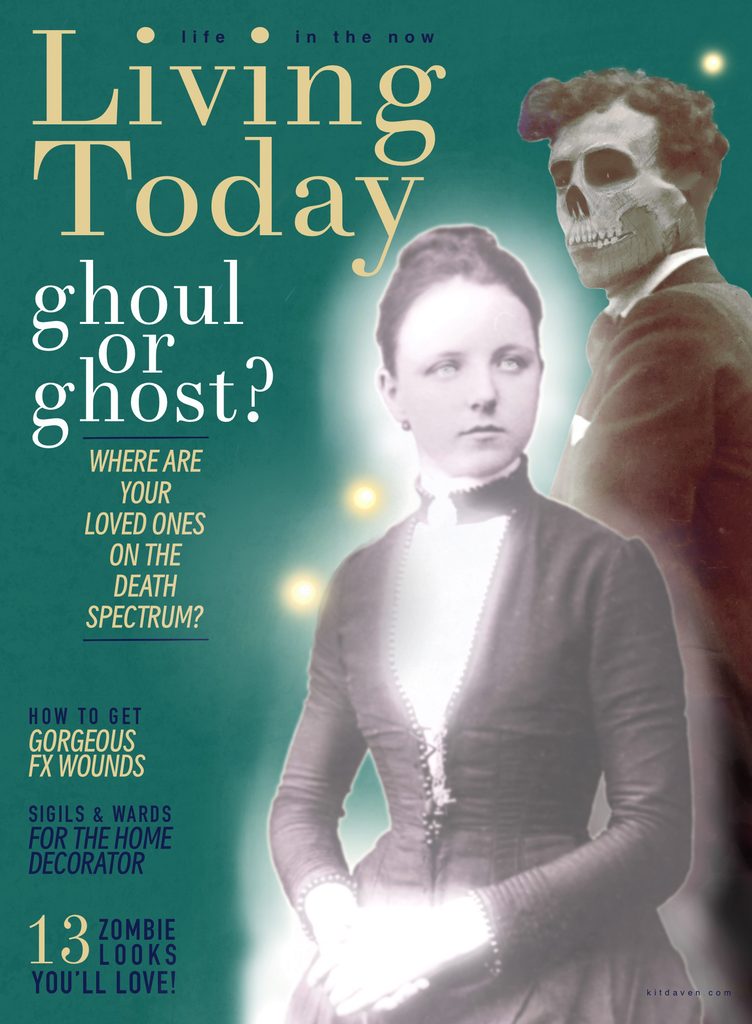
WHERE ARE YOUR LOVED ONES ON THE DEATH SPECTRUM?
By Eleanor Montague
FROM THE WALKING DEAD dropping the occasional body part to the full-bodied ghost to the faintest of orbs, life will never be the same.
Worldwide, death has immigrated to the shores of our living realm and taken control. Loved ones who’ve departed both recently and long ago bring unrest. What better way to face this lurid challenge than through understanding? Knowledge truly is power. So, here’s what you need to know about living with your familial Dead.
Ghouls
Sentient Sentinels
We call them ghouls, zombies, or the walking dead. In some youth subcultures online, ‘Icklies’ is a nomenclature quickly working its way into mainstream language. Regardless of what they are called, ghouls are not the soulless, flesh-eaters horror movies would have you believe.
Though they speak in an often creepy manner, ghouls are quite articulate and intelligent. They have thoughts and feelings and agency. Of all the Dead, they have the strongest hold on us on account of being material and tangible.
They are flesh and bone. Sometimes, they are only bone. Decay rates among ghouls embalmed before burial are slow, allowing them to endure in physic-ality. Among the Dead, ghouls dutifully watch the Living to ensure we wear our costumes and to en-force punishment on us when we don’t. For that reason, they are the dead-liest among the Dead.
Ghosts
Ethereal Souls
Spirits, spectres, spooks. There are a million names for these gossamer folks. They possess a million shades of translucency, since these are the Dead, whose bodies have fully decayed or been destroyed.
If your deceased loved one died recently and their spectral form shows no hint of translucency, don’t fret. That’s just a sign of our times.
Cremation has become a popular part of the inter-ment process in our modern world. In a year or two, light will eventually disrupt their spectral form, and their fading will begin.
Ghosts can be fun to live with. They can also be intrusive. Capable of hiding in some of the smallest spots or taking shortcuts through the Veil, these moaning mischief-makers will keep you guessing about their whereabouts. But beware! They can also be violent. With the right amount of focused rage, poltergeists can do as much physical harm as any ghoul.
Orbs
The Fading Essence
Orbs are the oldest of the Dead. Once full-bodied ghosts—most likely ghouls as well, going way back in time—they are on the verge of fading out of existence altogether. If you’re quiet enough, you can hear them whisper about their lives hundreds and hundreds of years ago.
You may not think specks of light soaring through the air can do much damage to the Living, and you’d be correct. On their own, orbs are harmless. They love positive energy and fun times and will dance about in the air.
However, don’t make a habit of tormenting orbs. Though their voices are mere whispers, they can still send an S.O.S. to other orbs. When enough of them gather in one place, they can swarm the Living and suffocate them.
Living with deceased loved ones doesn’t have to be treacherous. Creating a har-monious cohabitation with them is achievable.
Here are six ways to improve your relationships with the Dead:
1. Wear a costume at all times inside your home. They’ll appreciate you more for adhering to their demands.
2. Inscribe wards in a few select rooms of your home where you don’t want the Dead to go. (Your privacy is important.) This will create mystery and keep them occupied while they look for you. But don’t protect too many rooms to restrict their movements or they’ll suspect that you are hiding from them.
3. Ghouls aren’t restricted to wearing their burial clothes the way ghosts are. Be sure to give them fresh, modern clothes. And if they still have flesh, bathe them regularly. They will love you for helping them ease their decaying process.
4. Even though the Dead don’t eat, offering them a place at the dinner table will make them feel included in dinner time conversation.
5. Set up a dedicated space decorated with cherished items and photographs reminding them of their past and your connection with them.
6. Engage in activities that exude positive energy, such as playing music, dancing, or simply talking with them. Orbs are especially drawn to the warmth of shared joy.
Just remember, most departed loved ones mean you no harm when they flicker the lights or rearrange your belongings. It’s just their way of saying, “Hello!” Acknowledgement will go a long way to appeasing them.
However, if your deceased loved ones exhibit harmful behaviours, consider seeking a spiritual medium or paranormal expert to help resolve whatever issue the deceased may have with you. If there is no recourse for resolution, seek an exorcist to assist you in banning them from your home altogether.
Relationships with our beloved deceased ones are possible. They can be profound, enriching, and educational. By understanding the unique needs of ghouls, ghosts, and orbs, we can create a harmonious existence within our homes, finding deeper meaning in life while embracing the mysteries of what lies beyond death.
Eleanor Montague is a regular contributor to Living Today magazine and the author of the New York Times bestselling book, Ghost Talk: Communicating with & Understanding the Dead.
Read more…
Available in ebook and paperback online.
Paperbacks also available to purchase at the INDIGO store in Cambridge Centre, 355 Hespeler Road, Cambridge ON.